
Checking Criminal History in Forsyth County
No single search answers every Forsyth County criminal record question. Begin by defining the fact you need. A filed charge, hearing, plea, judgment, or sentence belongs in the clerk's case file. A current custody question belongs with the Forsyth County Sheriff's Office. A person who wants to see their own fingerprint-supported North Carolina record uses the State Bureau of Investigation's Right to Review process. Police reports stay with the agency that wrote them.
Gather the full name, alternate spellings, an approximate event date, and any case, citation, report, or booking number already known. A number is far safer than a name alone. Then work through the official channels in this order:
- Search the North Carolina eCourts Portal for Forsyth County cases and note the case number.
- Use the court-date tool if the narrow question is when and where a hearing is set.
- Check sheriff custody data for a very recent booking that may not yet be easy to find in court results.
- Ask the initiating police agency for its public report when the incident narrative or arrest facts are needed.
- Request a certified clerk search or your own SBI fingerprint review when an official product is required.
A common name can match more than one person. Compare only public case metadata and never assume identity from a name. Keep the case number from a sound match and give it to the clerk when asking for an older paper file or certified copy.
Forsyth County eCourts Record Search
Forsyth County joined eCourts in July 2025. Smart Search is now the main free public route for state court case information, but the system is not an SBI rap sheet and is not the clerk's certified statewide search. It can display filed charges, case status, court events, hearing dates, dispositions, judgments, money fields, and public documents. Each charge may have its own outcome, so read the charge and event areas before treating the overall case status as the answer.
The portal works best with a case number. A party-name search needs a Forsyth location filter and the criminal category when those controls appear. Older or pre-conversion documents may remain public yet not be downloadable. The Clerk of Superior Court is the fallback for those files.
| Portal control | Use | Required |
|---|---|---|
| Smart Search | Public case or party search mode | Yes |
| Search criteria | Case number or party name | Yes |
| Location or county | Narrow results to Forsyth | No |
| Case category | Choose criminal when shown | No |
| Advanced filters | Refine the displayed result set | No |
The official courthouse source shows the local court setting behind those records.
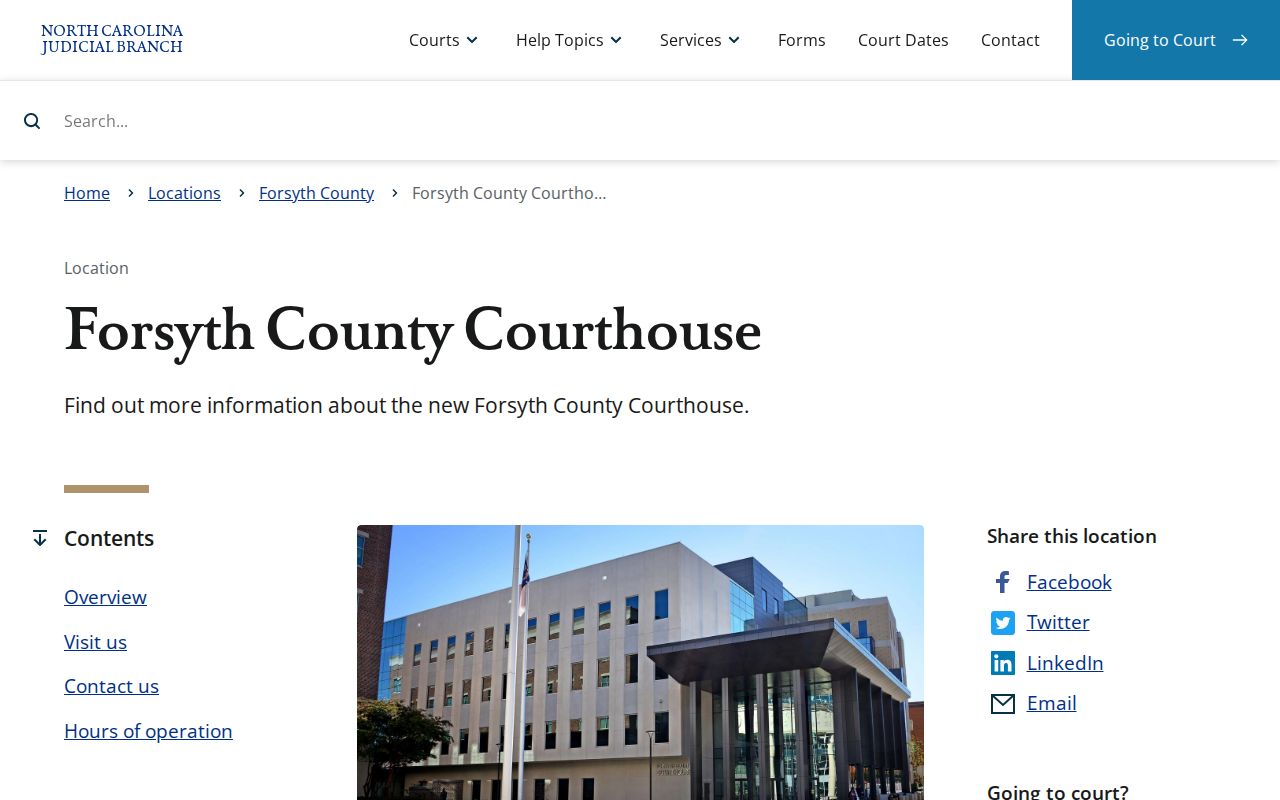
The courthouse image connects the electronic index to the clerk who maintains the underlying Forsyth County criminal case file.
North Carolina Official Background Checks
North Carolina offers several official products with different scope. The North Carolina State Bureau of Investigation, Criminal Information and Identification Section, is the central criminal information repository. It does not offer an unrestricted public name search. A person may request their own fingerprint-based Right to Review for $14 by mailing the form, original fingerprint card, and certified check or money order. Cash, cards, and personal checks are not accepted.
The Forsyth County Clerk of Superior Court provides a $25 certified statewide court-record search. That search is name-indexed, not date-of-birth verified. Supply every known name or alias and understand that juvenile, sealed, expunged, and unreturned warrant material is outside the ordinary result. The FBI's direct Identity History Summary costs $18 and is subject-only. A Winston-Salem fingerprint appointment can supply an FD-258 card, but the local fee was not published in the reviewed sources.
| Official product | Scope | Published cost |
|---|---|---|
| SBI Right to Review | Your fingerprint-based North Carolina record | $14 |
| Clerk certified search | Name-indexed statewide court records | $25 |
| FBI Identity History Summary | Your FBI-maintained identity history | $18 direct |
| eCourts Portal | Public state case information | Free |
| WSPD local arrest record | Local, uncertified arrest data without dispositions | Free |
The SBI background services source explains why its repository product differs from an open court search.
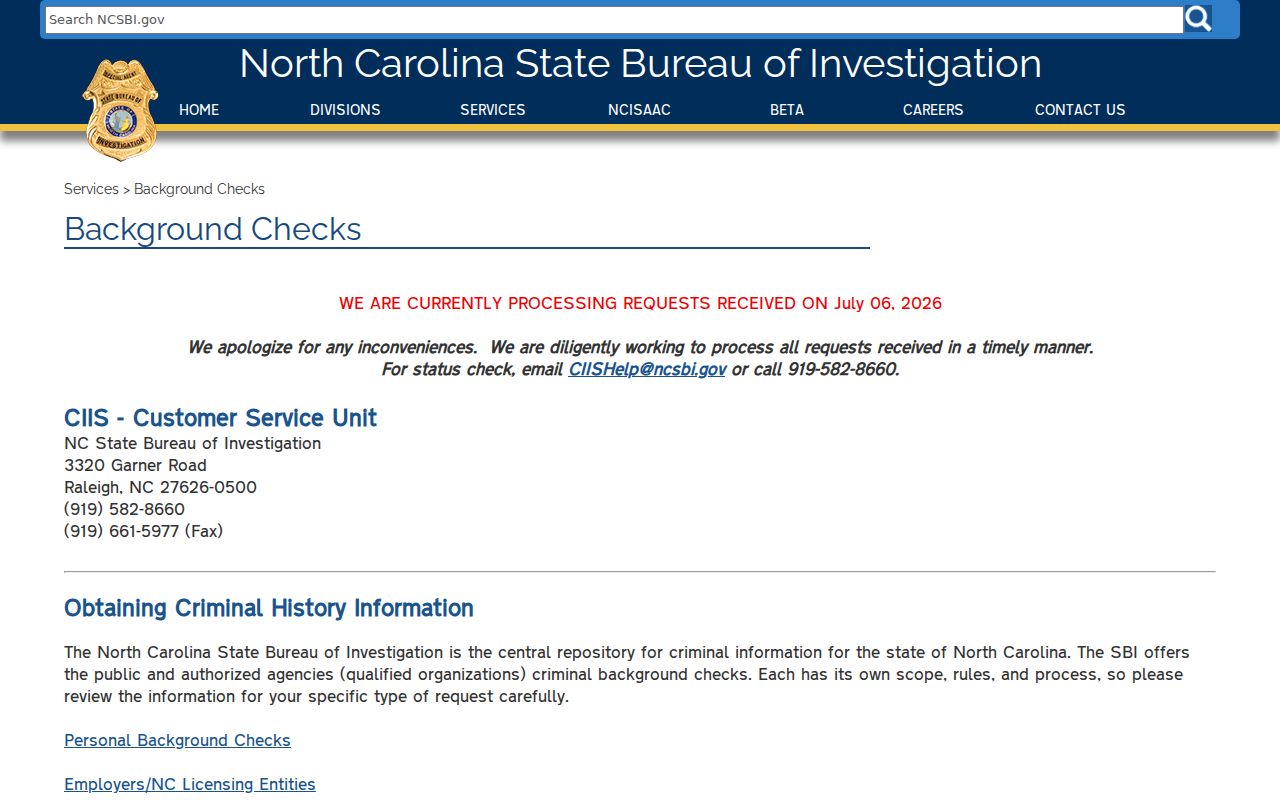
The SBI page is the right starting point for a subject's state record, status notices, and correction path.
Three Forsyth County Record Counters
Downtown Winston-Salem places three major record offices close together, but they cannot replace one another. The Clerk of Superior Court at 175 N. Chestnut Street maintains filed District and Superior Court cases and certified searches. The sheriff's Records Unit at 301 N. Church Street releases the public portion of FCSO-created incident records. The Law Enforcement Detention Center at 201 N. Church Street holds booking and present custody data. Winston-Salem Police records are kept separately at 725 N. Cherry Street.
Ask who created the record before walking to a counter. FCSO requires the report number and current North Carolina photo identification for its public incident front page. A full investigative report requires a judge-signed court order. The unit directs general criminal-history requests to the clerk. WSPD handles its own city reports and free local arrest-record product. That product has no court dispositions.
Forsyth Clerk of Superior Court
175 N. Chestnut St.
Winston-Salem, NC 27101
336-779-6300
Weekdays, 8:30 a.m.-5:00 p.m.
FCSO Records Unit
301 N. Church St.
Winston-Salem, NC 27101
336-917-7005
Weekdays, 8:30 a.m.-5:00 p.m.
Detention Center
201 N. Church St.
Winston-Salem, NC 27101
336-917-7600
Public lobby daily, 8:00 a.m.-8:00 p.m.
WSPD Records
725 N. Cherry St., Room 130
Winston-Salem, NC 27101
336-773-7922
Weekdays, 8:00 a.m.-5:00 p.m.
Forsyth County Criminal Record Types
One event can create several official files. The police incident file describes the response and alleged conduct. The jail booking file tracks intake, bond, and custody. A magistrate creates early court process. The clerk records what prosecutors file, what happens at each hearing, and how the case ends. Fingerprint-supported arrest data can reach the SBI repository and later be matched to a reported disposition.
Choose the file that answers the question:
- Incident or arrest report: request public facts from the agency that initiated the report.
- Booking record: use FCSO for jail intake, bond, custody, and release status.
- Criminal case file: use the clerk for filed charges, hearings, pleas, judgments, and sentences.
- Warrant information: check FCSO public modules and confirm filed process with the clerk.
- Corrections record: use NCDAC for state custody and public supervision information.
- Registry listing: use the SBI registry only for people legally required to register.
The Forsyth County arrest lookup process explains the line between an agency report and a later court result.
Forsyth County Jail and Warrant Records
The sheriff's Police-to-Citizen interface separates Inmates, Recent Arrests, Wanted Persons, and Most Wanted. Each module answers a different question. A person released from the Forsyth County jail may remain in a recent booking result while no longer appearing as a current inmate. Most Wanted is a selected agency list, not a complete warrant inventory. NCAWARE is the statewide justice system used to issue and track process, but it is not open as a general public warrant portal.
If the interface fails, call the detention center for current custody, call sheriff administration for warrant routing, and search eCourts for related public case events. The clerk can address filed bench process. Someone resolving their own possible warrant should confirm the case number and status through official staff rather than rely on an old screen capture. Only a judge can recall or change court process.
The official sheriff source leads to county records and detention services.
The sheriff navigation is the local gateway for agency reports, jail custody, and public warrant tools.
Note: A current inmate result shows custody, while a wanted-person result concerns process and neither one proves a criminal conviction.
Inside a Forsyth County Criminal Record
A Forsyth County criminal record changes shape by custodian. An SBI record links identity and fingerprint transactions to arrest cycles and reported outcomes. An eCourts file centers on the case and its charge sequence. A booking profile focuses on jail operations. Compare identifiers and dates across products instead of expecting one screen to contain the whole history.
| Name and identifiers | Legal name, aliases, birth data, case number, booking number, or state and FBI identifiers, depending on the file. |
|---|---|
| Arrest and booking | Arrest date and agency, intake time, custody status, facility, release, and bond fields. |
| Charges and statutes | Allegation or filed offense, offense date, class, sequence, and legal citation. |
| Disposition | Plea, dismissal, acquittal, conviction, or another charge-level outcome with a date. |
| Sentence | Judgment, active or community punishment, conditions, costs, and supervision when public. |
| Events and documents | Hearings, docket entries, filed documents, related cases, and scheduled court activity. |
- Disposition
- The final recorded action on a charge, such as dismissal, acquittal, or conviction.
- Prayer for judgment continued
- A North Carolina judgment outcome with legal effects that depend on the facts and later action.
- Order for arrest
- North Carolina court process often issued after a required court appearance is missed.
- Expunction
- Statutory removal of qualifying material from ordinary public and official access.
Financial fields need the same care. Bond, court costs, fines, restitution, and a case balance are distinct entries, and a zero balance does not show that a Forsyth County charge was dismissed.
Forsyth County Sheriff Record Limits
FCSO's public report rule is narrow. A member of the public may obtain the front page of an FCSO incident report in person after making a written request, presenting valid North Carolina identification, and supplying the officer's report number. Requests after 4:00 p.m. move to the next business day. A full incident report needs a court order signed by a judge. Juvenile-related requests require a parent or legal guardian and a birth certificate.
A Chapter 132 request may describe other releasable records, but investigative narrative remains governed by the special law-enforcement record limits. No general records email, fax rule, drop box, base copy fee, or guaranteed response time was published in the reviewed sheriff source. Call the Records Unit before a trip if the number or status is unclear. The agency-of-origin rule still controls.
The FCSO incident-report source sets out those identification and access rules.
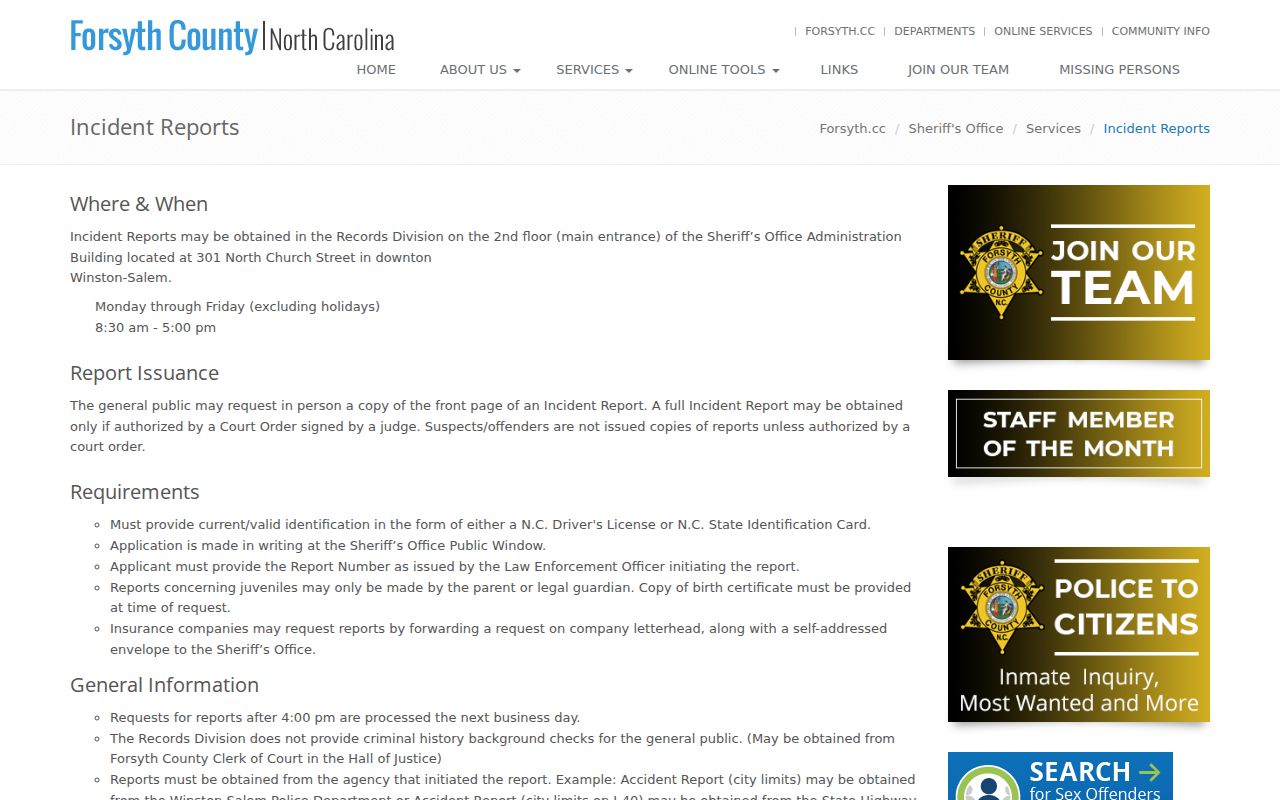
The published rule explains why the public front page and the full investigative file are not the same product.
North Carolina Public Access Laws
North Carolina Public Records Law starts with broad access, then specific statutes limit criminal justice material. That means the custodian and record type matter as much as the word “public.” Core incident and arrest facts can be open while investigative details remain withheld. Court staff redact protected identifiers. Juvenile, sealed, and expunged matters do not appear like ordinary adult files.
Key statutes:
G.S. 132-1 defines public records and the basic right to inspect or copy them.
G.S. 132-1.4 opens specified incident and arrest facts but protects most investigative records.
G.S. 132-1.4A gives law-enforcement recordings a separate disclosure and release process.
G.S. 15A-146 governs qualifying dismissed and not-guilty expunctions.
G.S. 14-208.10A controls public registry access and bars improper use.
Ask for the least costly available medium and identify the agency, event date, place, report number, and public fields sought. Broad wording can slow the custodian's work and will not override a statutory exception.
Forsyth County Arrest Record Flow
A Forsyth County arrest begins with the officer's report. At the Law Enforcement Detention Center, staff create a separate booking entry, take fingerprints and a booking photograph, screen health and safety needs, and record custody and bond. A magistrate handles the first appearance and release conditions. The clerk opens the case stream, and prosecutors decide what charge proceeds. District Court hears misdemeanors and early felony events. A felony that continues is tried in Superior Court.
Record flow: Arrest report › LEDC booking › magistrate process › District 31 case file › disposition › SBI matching.
The last link can take time. Different identifiers, a changed charge, or delayed reporting may leave a fingerprint record without the latest Forsyth County court result. For a correction, obtain your Right to Review, identify the arrest cycle, and pair it with a certified disposition. The SBI personal-review source details the fingerprint and mail process.
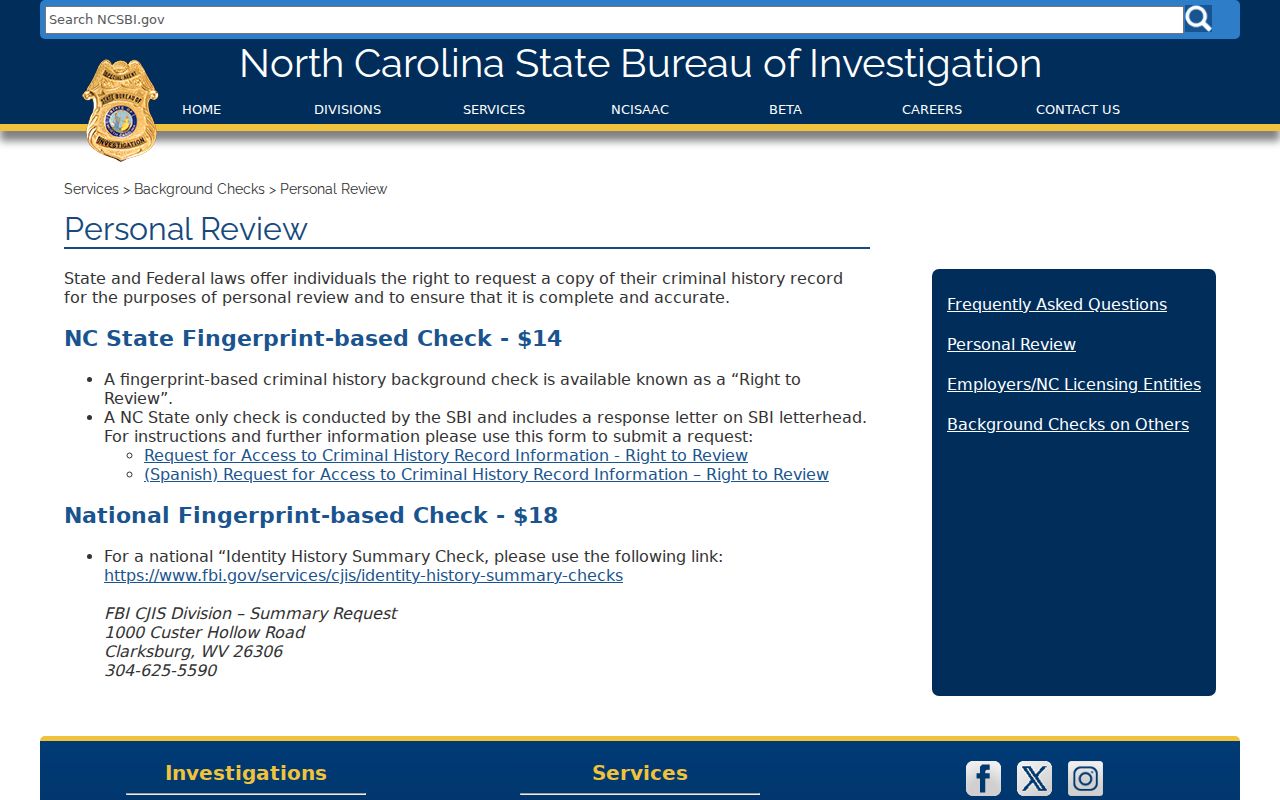
The Right to Review route is designed for a person to inspect the state record linked to their own fingerprints.
Sealed, Expunged, and Restricted Records
Expunction is North Carolina's statutory term, but it is not one universal remedy. G.S. 15A-146 covers dismissed and not-guilty charges. Qualifying charges disposed on or after December 1, 2021 may receive automatic relief after the statutory processing window. G.S. 15A-145.5 covers some nonviolent convictions and excludes many serious, assaultive, registrable, stalking, sex, and drug offenses. Eligibility and waiting periods depend on the exact record.
A petition normally goes to the Forsyth County Clerk of Superior Court, uses official AOC forms, and may require case data, affidavits, review, and a judge's order. Many petition provisions carry a $175 fee, with indigency relief, while some dismissal or not-guilty routes have different treatment. After an order, state and local databases may not update at the same time. Check the public court result and use SBI Right to Review if the old cycle still appears.
Juvenile records, victim and witness identifiers, investigative narratives, and law-enforcement recordings also follow special access rules. Restricted does not always mean destroyed. Some justice agencies retain confidential access where the statute permits it.
Forsyth County Courthouse Record Change
The current Forsyth County Courthouse opened in October 2023 at 175 N. Chestnut Street. It replaced the old Hall of Justice and consolidated courtrooms and public-facing offices. Some older official pages can still point to the former address, so use the Judicial Branch location before visiting. The courthouse and nearby sheriff offices may seem like one downtown records cluster, yet each counter holds a distinct file.
A local administrative order effective November 10, 2025 broadly bars phones, computers, tablets, cameras, smart watches, smart glasses, and other recording or transmission devices unless an exception applies. A person planning to photograph a terminal or paper document should confirm the clerk's current copy method instead. Security screening also applies.
Leave prohibited electronics secured before entry. The order is more than a minor visit rule because it changes how a Forsyth County criminal case search can be documented at the counter.
Forsyth County Criminal Records by City
City police reports remain with the agency that created them, but Winston-Salem, Kernersville, and Clemmons do not run separate municipal criminal courts. Their criminal and ordinance matters enter North Carolina District or Superior Court. The city guides focus on the first local records counter, the booking route, and the jurisdiction issues that can change where a request goes.
Kernersville requires an extra county check because the town crosses into Guilford County. Clemmons uses the Forsyth County Sheriff's Office instead of a village police department, while Winston-Salem maintains its own police Records Division.
Winston-Salem Criminal Records
257,271 residents · WSPD keeps city reports, while cases go to District 31.
Kernersville Criminal Records
29,128 residents · The town crosses the Forsyth-Guilford county line.
Clemmons Criminal Records
22,808 residents · FCSO provides contracted law enforcement.
Forsyth County Federal Criminal Records
Federal cases sit outside Forsyth County eCourts. The county is within the U.S. District Court for the Middle District of North Carolina, and PACER is the official federal docket and document system. Federal custody appears in the Bureau of Prisons locator, while state sentences use NCDAC and local pretrial custody uses FCSO. Those systems should not be combined into one assumed status.
The Hiram H. Ward Federal Building in Winston-Salem handles case inquiries, but filings and correspondence go to the staffed clerk in Greensboro. PACER fees and thresholds can change. Its announced January 2027 fee schedule should not be applied early to an August 2026 search.
The Bureau of Prisons source is the federal custody layer.
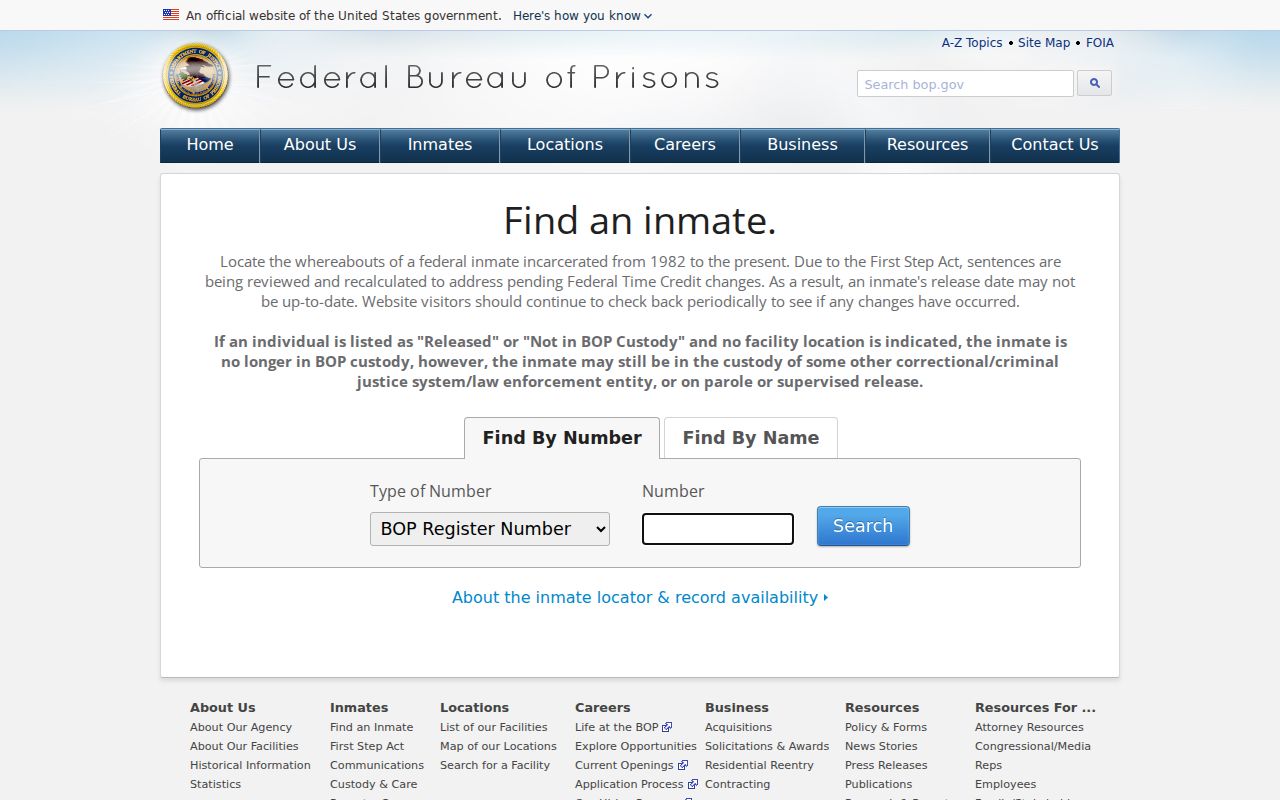
The locator helps separate federal confinement from county jail and North Carolina correctional records.