
Forsyth County Criminal Court Cases
Forsyth County uses North Carolina's unified General Court of Justice. District Court hears misdemeanors, traffic matters, and preliminary felony proceedings. Superior Court tries felonies that move forward. Both are part of Judicial District 31, and both rely on one Clerk of Superior Court. A Winston-Salem, Kernersville, or Clemmons arrest does not create a separate municipal criminal file. The city or town agency may hold an arrest report, but the filed charge enters the state court system.
The Clerk of Superior Court at 175 North Chestnut Street keeps the public case record. That file can show what prosecutors filed, how each charge changed, what hearings occurred, and how the court resolved the matter. The sheriff's Records Division cannot certify that outcome. Its own guidance sends general criminal-history requests to the clerk. The official Forsyth County court services page introduces the local courts and services.
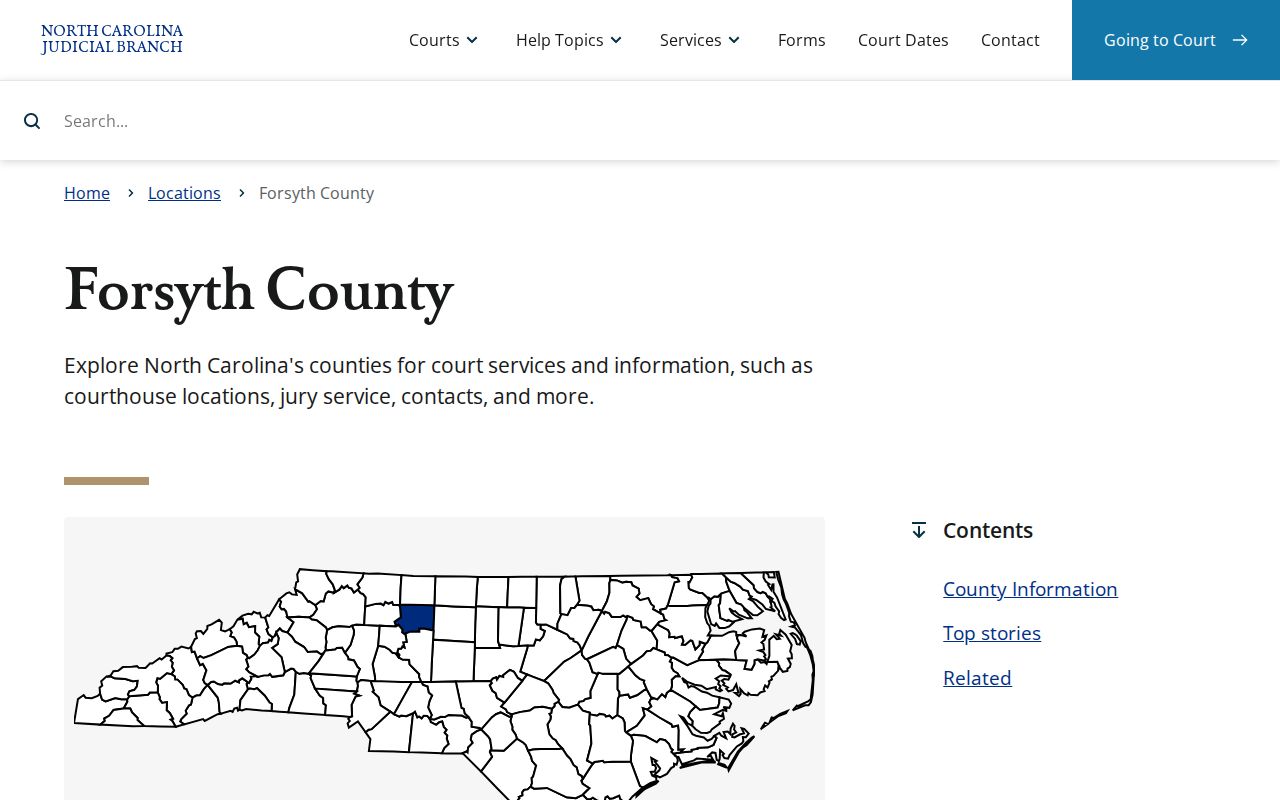
The county court page is the local starting point for schedules, forms, courthouse details, and links into the statewide case tools.
Forsyth County eCourts Smart Search
Forsyth County joined North Carolina eCourts on July 21, 2025. The public Portal is now the main remote channel for case information. Smart Search accepts a record or case number for the closest match, or a party name when the number is unknown. The county and criminal filters help separate Forsyth County court cases from similar names elsewhere in the state. Search results can lead to charges, events, hearings, public documents, and financial fields when those items are available.
The official North Carolina eCourts Portal is free to search, and the Judicial Branch's Portal FAQ explains public access and document limits. A name match is not proof of identity. Compare the case number, county, case type, filing details, and charge data before treating a result as the right file.
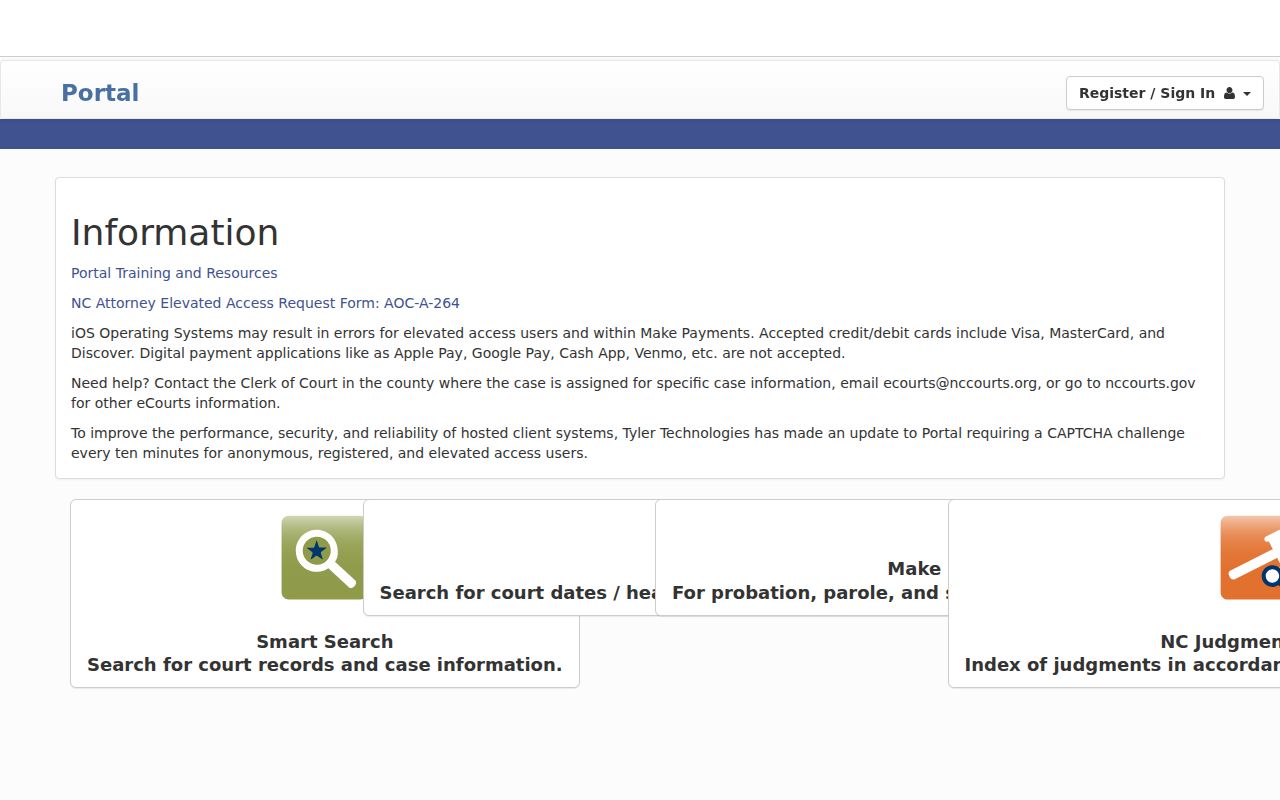
The Portal image shows the statewide interface that Forsyth County readers use, while the clerk remains the fallback for a certified or unavailable record.
Searching Forsyth County Case Records
Begin online when the case is likely in eCourts, but keep the clerk channel in view. Portal coverage and document availability are not the same as legal access. Some pre-conversion material may not be downloadable. A specific case number is the best bridge between remote results and a clerk request.
- Open Smart Search in the North Carolina eCourts Portal.
- Enter the case number, or search the party name with careful spelling.
- Apply Forsyth County and criminal case filters when the results allow it.
- Open the match and review each charge, event, hearing, and document entry.
- Save the case number and ask the Forsyth County clerk for certified or unavailable material.
| Field Label | Type | Required | Notes |
|---|---|---|---|
| Smart Search | Tab or mode | Yes | Main public case and party search |
| Search criteria | Text | Yes | Case number or party name; exact format affects results |
| Advanced filters | Expandable | No | Options depend on the result context |
| Location or County | Filter | No | Choose Forsyth to reduce same-name matches |
| Case category | Filter | No | Select criminal when shown |
| Search or Clear | Buttons | Search only | Run or reset the query |
If Forsyth County case records do not appear, try every known name and confirm the spelling. Then take the case number, charge date, or other clear facts to the clerk. The Judicial Branch's court-record instructions describe online and counter access. Older Forsyth County material may require a clerk request. Do not treat an empty Portal result as proof that no court file exists.
Forsyth County Court Dates Compared
North Carolina Court Dates answers a narrower question than Portal. It helps locate when and where a matter is scheduled through name, citation number, and county searches. It does not replace the full case event history or a certified disposition. Use it when a near-term appearance is the concern, then use Portal or the clerk to read what happened in the file.
The official North Carolina Court Dates search provides the schedule channel. A date on that screen can change, so the case file and current calendar remain the right checks before relying on a saved result.
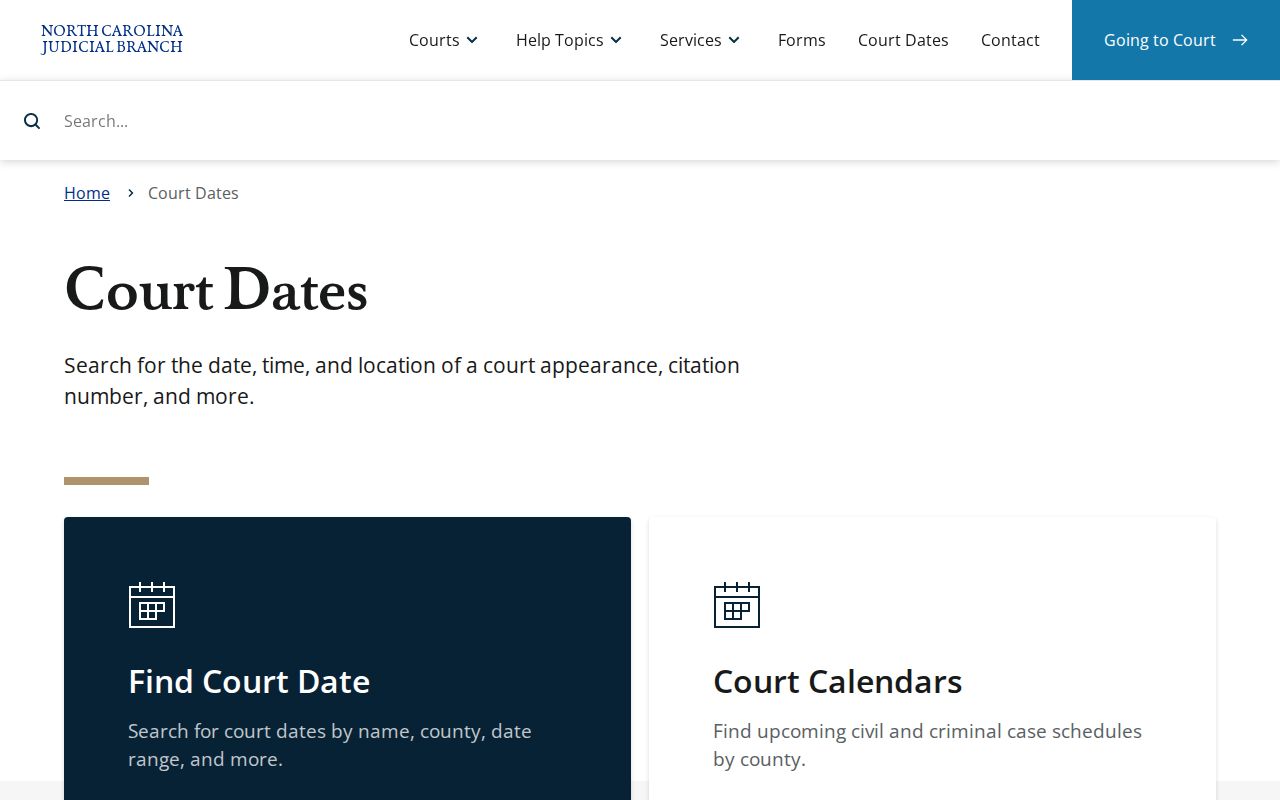
This schedule tool complements Forsyth County eCourts data, but it should not be read as a complete criminal-case outcome.
Inside a Forsyth County Case File
A public case file is built around the court's case number and each filed charge. It may contain party and attorney fields, offense data, event entries, hearing notices, public documents, disposition, judgment, sentence, and assessed money fields. Charge sequences matter. One count may be dismissed while another ends in a plea or verdict, so the case-level status alone can hide a mixed result.
| Case Number and Court | Unique court reference, Forsyth location, division, case category, filing date, and status |
|---|---|
| Filed Charges | Offense text, statute, offense date, class, and sequence for each count |
| Register of Actions | Dated docket events, filings, and procedural steps entered by the clerk |
| Hearings | Scheduled date, time, location, type, and later event history |
| Disposition and Plea | Outcome and date for each charge, including dismissal, acquittal, plea, or conviction |
| Judgment and Sentence | Court-ordered punishment, conditions, and monetary entries when public |
Protected identifiers and sealed, juvenile, or expunged material do not belong in unrestricted public view. A missing online document may still require a direct access decision by the clerk.
Forsyth County Case Outcome Terms
North Carolina docket terms describe different acts, not shades of the same result. A dismissal ends a charge without a conviction. An acquittal follows a not-guilty finding. A no bill means the grand jury declined the proposed indictment. A conviction follows a guilty plea or verdict. A pending label means the court has not entered a final outcome for that charge.
- Arraignment
- The hearing at which the charge and plea are addressed.
- Disposition
- The recorded outcome for a charge or case.
- Prayer for judgment continued
- A distinct North Carolina judgment disposition with consequences that depend on context.
- De novo appeal
- A District Court criminal appeal that starts again in Superior Court.
- Judgment
- The court's formal entry of the result and sentence.
Read the final disposition offense and class. The arrest allegation or first filed charge may not be the offense that controls the final judgment.
How a Forsyth County Case Moves
A criminal case may begin with a citation, summons, warrant, or arrest. District Court handles misdemeanors and the first stages of many felonies. A felony that proceeds can move through indictment or another proper charging path to Superior Court. Prosecutors may amend or dismiss charges, while the clerk records the events and outcomes. The local District 31 docketing plan publishes performance goals after indictment, but those targets are not promises for any one case.
Case flow: Charges Filed › Arraignment › Pretrial › Plea or Trial › Disposition › Sentencing
After judgment, later entries can include compliance matters, probation proceedings, appeals, or an expunction petition. Each step has its own date and document trail. A new entry does not erase the earlier steps, and an appeal can change which court holds the active part of the Forsyth County criminal case.
Forsyth County Court Division Split
The offense level and stage determine the courtroom, not the arresting agency's city. District Court initially handles misdemeanors, traffic matters, and preliminary felony events. Superior Court tries felony cases and hears District Court criminal appeals anew. Both sets of Forsyth County criminal court cases remain within the state system and under the same local clerk.
The Forsyth County Courthouse opened in October 2023 and places key clerk functions in the new building. A local electronics order effective November 10, 2025 broadly prohibits phones, computers, tablets, cameras, smart watches, smart glasses, and other recording or transmission devices unless an exception applies. The state's felony and misdemeanor provisions also show why division and charge class must be read from the file. Confirm the clerk's current copy method before going.
Case Record Access & Restrictions
North Carolina law broadly supports access to public records, but another law or court order can restrict a file or field. Juvenile cases, expunged matters, sealed records, protected victim data, and sensitive personal identifiers are not ordinary public material. Online redaction can also make a Portal view narrower than a public paper record, while some documents are unavailable online even though the case index appears.
For a certified statewide court search, the Judicial Branch's criminal background check instructions use form AOC-CR-314 and a $25 fee. The certification relies on name indices, not date of birth. Supply all known aliases and review common-name matches with care. The form excludes juvenile records and ordinary access to sealed material and unreturned warrants. Ask the clerk about certified-copy charges because the reviewed county page did not publish the exact amounts.
Forsyth County Federal Criminal Dockets
Federal criminal files do not appear in North Carolina eCourts. Forsyth County lies in the U.S. District Court for the Middle District of North Carolina, and PACER is the official federal docket and document system. This separate layer matters when a name search in the state Portal produces no match for a known federal matter. The Middle District of North Carolina identifies the federal court serving Forsyth County.
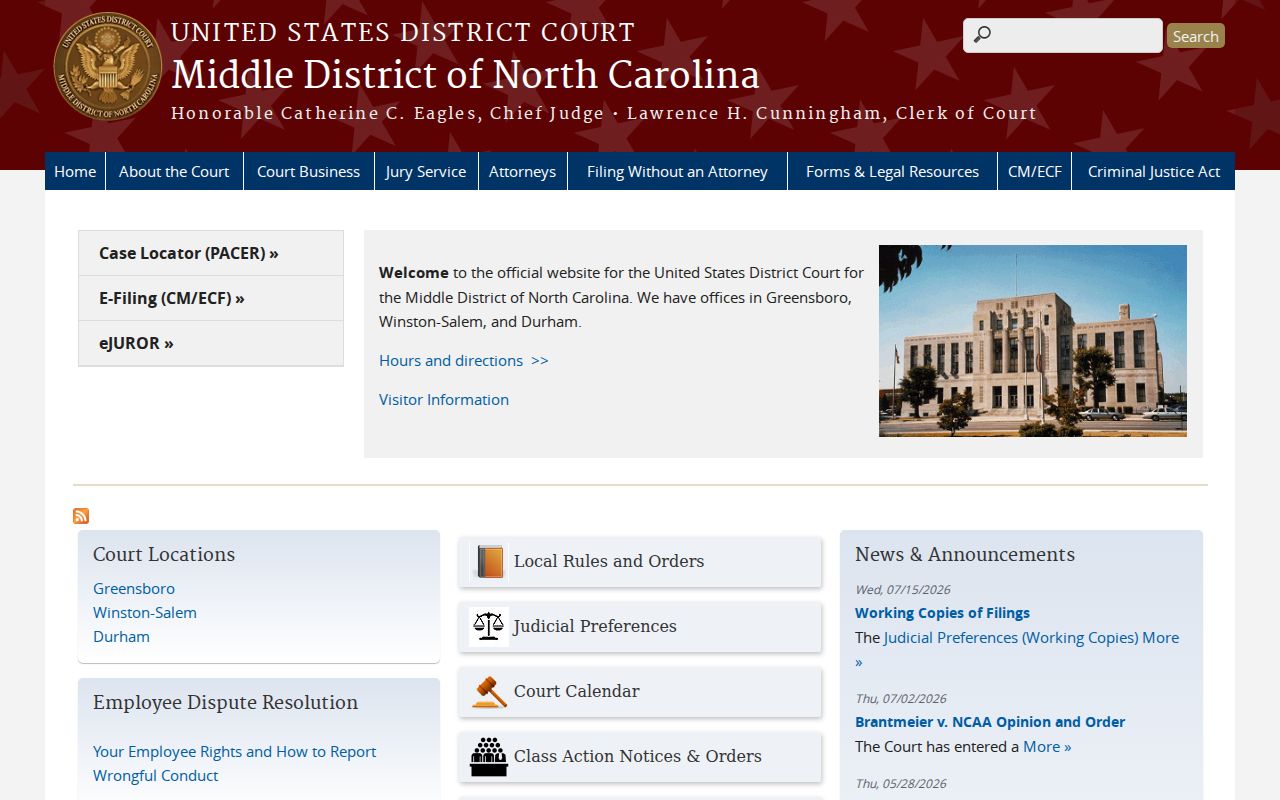
The local Winston-Salem location is in the Hiram H. Ward Federal Building, though filings and correspondence go through the staffed Greensboro clerk address stated by the court.
The official PACER case access system requires an account and may charge under its current fee schedule.
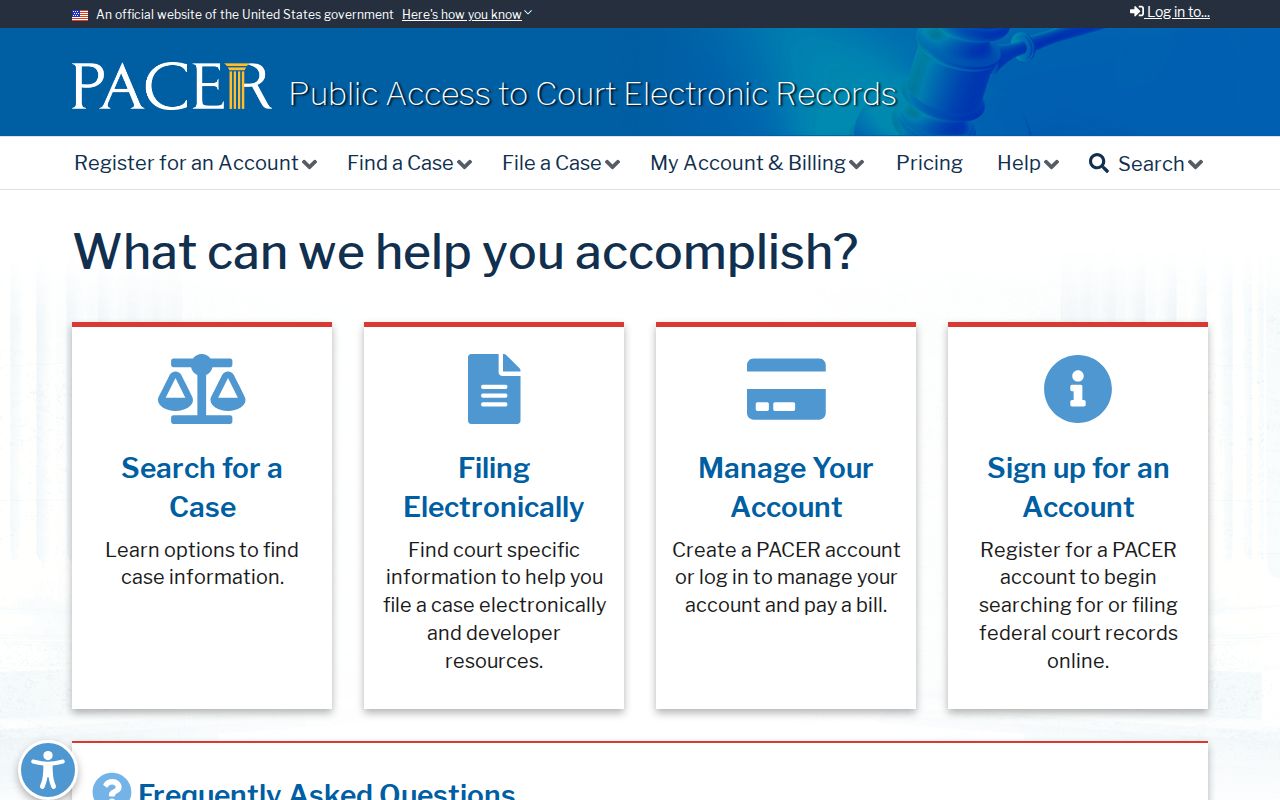
PACER covers the federal docket layer; it does not certify a Forsyth County District or Superior Court result.